

AFRICA FINTECH OVERVIEW
PUBLIC MARKETS
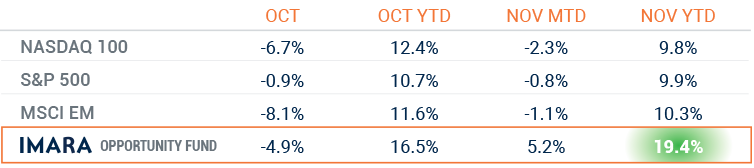
The Imara African Opportunities Fund, investing in listed fintech and payment companies, is down -4.9% in October. The Fund is up 16.5% October YTD, notably higher than the Nasdaq at 12.4%, the S&P 500 at 10.7% and MSCI EM at 11.6%.
What’s really interesting is how much STRONGER our bounce-back has been so far in November. For the month of November so far, we are up 5.2%, with the Nasdaq down -2.3%, the S&P 500 down 0.8% and MSCI EM down 1.1%.
Despite our strong relative performance, October was a tough month. A key driver was the depreciation of the EGP. That might sound bad, but its actually a good development. Short term pain, long term gain. A currency is supposed to be a free floating, price discovery mechanism. It acts as an important pressure outlet. In my 21 years of African investing and my 26 years of EM investing, the single worst thing that can happen to a country is for its Central Bank to peg and freeze up its FX rate and market. I was greatly encouraged by Egypt’s Central Bank letting the EGP find its own price. Lo and behold, it has actually strengthened, as the fear of Egyptian involvement in the Houthi-Saudi conflict abated. The confidence that engenders for foreign investors cannot be underestimated. Governor Hassan Abdalla deserves a medal.
Amidst this weakness, Governor of the Central Bank of Egypt (CBE) Hassan Abdalla affirmed that maintaining a flexible FX regime for the EGP is one of the bank's primary objectives, alongside price stability and continued inflation reduction. Speaking at the Egypt Forum, Abdallah said: “We are committed to a flexible exchange rate, and we hope society understands that these movements are normal,” adding that “the exchange rate moves in response to the circumstances around us.” The Governor stressed that a stable exchange rate despite changing conditions, rather than market-driven fluctuations, should raise concern. The Governor explained that Egypt's previous adherence to a fixed exchange rate led to the emergence of a parallel currency market. He stressed that the CBE does not target a specific FX rate for the currency, but rather ensures that its value is determined by market mechanisms. The Governor went on to emphasise that a flexible exchange rate is the first line of defense for the Egyptian economy, but not the only one, warning that multiple exchange rates are amongst the most significant risks threatening economic stability.
VENTURE CAPITAL AND PRIVATE EQUITY DEAL UPDATE
- Cross-border payments platform Pesa has launched in Australia, opening a route for customers to send money between Australia and Nigeria. With local regulatory authorisation and direct access to Australian payment infrastructure, the company aims to cut hidden exchange-rate markups and speed up transfers.
- Egyptian fintech MNT-Halan launched a USD149.7 million IPO, the country’s biggest stock-market listing since 2021. The offering, which covers 20% of MNT Tech Holding, its Egyptian arm, values the business at about USD745 million.
- PawaPay has secured a payments licence in Mozambique, allowing it to onboard merchants directly instead of relying on third parties. The approval gives it access to more than 12 million active mobile money accounts across networks including M-PESA and e-Mola, extending its reach in Africa.
- CapitalSage completed its acquisition of Chimoney, the Nigerian-founded payments startup that announced it was shutting down in May after running out of cash. The all-cash deal brings its cross-border payments infrastructure back into operation, while its consumer app has relaunched as Tiki.
- Kenyan fintech Cloud9 raised $500,000 from New York-based accelerator Alliance, bringing its disclosed funding to $1 million. The digital banking startup plans to expand cross-border payment routes, introduce virtual and physical cards, and help more African businesses manage international transactions.
- M-KOPA acquired Finnish software company KilpiTek Oy in an $8 million deal, bringing a key part of its smartphone-financing technology in-house. KilpiTek’s software can remotely lock financed devices when customers fall behind on repayments, helping protect M-KOPA against missed payments.
ECONOMIC AND POLITICAL OVERVIEW
NIGERIA
The Federal Government plans to introduce incentives to encourage privately owned businesses to list on the Nigerian Exchange Limited (NGX), as part of efforts to increase the number of listed companies from 146 to 250 by 2036.
Dangote Refinery’s USD1.6bn IPO could increase the number of active investors in Nigeria’s capital market by as much as fivefold. This is according to the Nigerian Exchange Group (NGX Group), that runs the Nigerian Stock Exchange. Furthermoe, the IPO has reportedly attracted subscriptions several times above its original fundraising target, with a 4x subscription of the NGN2.2tn offer value, translating to about NGN8.6tn.
The Federal Government expects Nigeria’s 2026 fiscal deficit to fall below its budget target of 4.2% of GDP, as improved revenue and declining borrowing costs ease pressure on public finances.
Nigeria’s FX reserves rose to USD59bn in October 12, 2026, their highest level since November 19, 2008, when reserves stood at approximately USD58.9bn.
Macro releases included (September stats):
- Inflation decreased to 14.63% y/y (August: 15.39%).
- FX reserves increased to USD 54.9bn (August: USD 53.3bn).
- PMI was 56.4 (August: 54.3).
EGYPT
Rating agency Moody’s upgraded Egypt’s long-term sovereign credit rating for both local and foreign currency to ‘B3’, while maintaining a positive outlook, citing progress in economic and fiscal reforms that have helped stabilise public finances, improve foreign reserves and accelerate economic activity. Moody’s also upgraded its rating for foreign-currency unsecured debt issuances while maintaining a positive outlook. The agency said the upgrade is supported by fiscal consolidation efforts and structural reforms, which have put government debt and interest burdens on a downward trajectory. Moody’s noted that continued fiscal discipline and further reforms could reduce gov’t debt and debt-servicing costs faster than it currently expects, justifying its decision to maintain a positive outlook on Egypt’s credit rating.
Egypt aims to increase its airports' annual passengers to more than 122mn by 2030, with projects underway to increase capacity at several airports, Civil Aviation Minister Sameh Elhefny said on Thursday. Egypt's airports currently have an annual passenger capacity of 73mn, with Cairo Airport handling over 31mn passengers. Cairo Airport Terminal 4, with estimated investments of USD4.2bn, is expected to raise the airport's annual passenger capacity to 70mn in its first phase, with a longer-term target of 110mn passengers annually after 2041. Upcoming projects at El-Alamein, Sphinx and New Capital airports are expected to add c12mn passengers annually to the country's total airport capacity.
Egypt aims to raise economic growth to 6.8%, lower inflation to 7%, and reduce unemployment to 5.5% by FY29/30 under a national economic transformation programme focused on productivity, job creation and improving living standards, Planning and Economic Development Minister Ahmed Rostom said on Thursday. Speaking at a session on the National Economic Transformation Programme on the fourth day of Egypt Forum 2026, Rostom said the gov’t was shifting its focus from achieving economic stability through previous reforms to improving the quality of growth. He said the programme is built around four main pillars and sets out 40 targets and 185 priority measures, backed by 20 legislative and 25 institutional reforms, adding that the gov’t will track progress through 150 performance indicators. The programme prioritises five promising sectors: agriculture; manufacturing; information and communications technology (ICT); tourism; and energy. Together, these sectors account for c40% of GDP and contribute c50% of real economic growth, Rostom said. The gov’t aims to strengthen these sectors' contribution to economic growth and productivity, expand employment opportunities in faster-growing activities, develop digital and technical skills, and increase citizens' incomes. The Minister emphasised the private sector's central role in the transformation programme, saying it accounts for 80% of GDP, 58% of total investments and 83% of total employment (employing nearly 27mn workers).
Egypt plans to add 3.3 GW of solar and wind power generation capacity to the national grid during 2027, bringing the total renewable energy capacity to 12.8 GW, according to a gov’t official. These plans fall short of the Ministry of Electricity's target of 16.8 GW by the end of 2027, according to the latest data issued by the Ministry. The targeted capacity constitutes of 1.6 GW of wind power and 1.7 GW of solar power.
Macro releases included (September stats):
- Inflation was 13.9% y/y (August: 14.5%).
- FX reserves were USD 57.3bn (August: USD 57.2bn).
- PMI decreased to 47.2 (August: 49.6).
KENYA
Kenyan consumer goods manufacturer Kenafric Group has launched a USD10m fund to help young African businesses expand their operations and reach more customers. The fund, known as Kenafric Ventures, will invest between USD100k and USD2m in businesses that have already attracted customers and are ready to grow.
Banks record a sharp improvement in loan performance as private-sector credit expands, but the billions still owed by struggling borrowers expose the fragile relationship between lending, household incomes and business survival.
Kenyan businesses are exploiting only a fraction of the export opportunities available in the European Union despite duty-free access to the market Kenya Association of Manufacturers has said. The lobby says despite an increase in the number of exports to EU in the past two years when Economic Partnership Agreement took effect, it represents only about 10% of the potential.
Macro releases included (September stats):
- Inflation was 6.8% y/y (August: 6.6%).
- PMI increased to 51.3 (August: 49.7).
MOROCCO
Morocco’s 2027 draft budget bill proposes a gradual income tax reform and higher pensions to help a recovery in purchasing power and boost the middle class, Finance, Economy and Public Efficiency Minister Fouzi Lekjaa told lawmakers in a live broadcast. The planned tax reform will exonerate 87% of salaried workers from paying an income tax as of Jan 2027. Reform will raise annual salaries of workers exonerated from paying income tax by 50% to MAD60,000 as of Jan 2027. It also lowers income tax percentages for higher earners. These income tax reforms are set to cost the Treasury MAD5.5bn in 2027. The draft budget bill also proposes spending MAD10bn on raising pensions as of Jan 2027 for 931,000 beneficiaries. Moreover, the bill proposes exempting some 60% of electricity users in Morocco from paying bills that are below MAD100/month. It also raises the minimum amount of social welfare checks for most vulnerable households by 20% to MAD600/month at a total cost of MAD3bn. The draft bill projects economic growth of 3.7% in 2027 vs 4.7% in 2026 and targets maintaining the budget deficit at 3% of GDP.
The budget resembles a major change of focus and tone by the new gov’t, which was established a couple of weeks ago following Sep’s elections. The Finance Minister stated clearly that the budget reflects a break “with neo-liberal” policies under the previous administration, vowing to protect the middle class. Nevertheless, the gov’t is promising no fiscal loosening as a result of the various social measures, targeting to keep the fiscal deficit unchanged at 3% of GDP. The shift in tone was largely expected following years of protests in the country, which reflected underlying social pressures, including the latest wave of protests last year dubbed as “Gen Z” protests.
Macro releases included (September stats):
- Inflation was 0.5% y/y (August: -0.3%).
MAURITIUS
Macro releases included (September stats):
- Inflation was 5.7% y/y (August: 4.9%).
- Bank of Mauritius (BoM) moved the interest rate to 4.75%.
COMPANY UPDATES
Key to brackets: (country, industry)
MARKET OUTLOOK
Africa is expected to outperform the rest of the world with an improved outlook in 2026. We continue to allocate to high quality businesses; those that score highly on our internally developed, Likert Q-scoring system, both currently and over time. We have two additional quantitative overlays, valuation and growth. We also have two qualitative overlays being management and ESG. What is particularly exciting is that we have a number of businesses across Africa that fit these criteria. The key transformational trends of financial inclusion, urbanisation and economic formalisation underpin a robust African consumer story that is taking shape regardless of global volatility. We allocate to the best companies in the sectors that tap into this transformation. At the moment, we have a bias towards financial inclusion and fintech themes as they do particularly well on our growth metrics.
NIGERIA
The new President is taking reforms seriously, a hugely positive signal to the markets. The communications, fintech and banking sectors are growing strongly, yet high quality companies exploiting these, are at all time low valuation multiples.
EGYPT
The short term outlook for Egypt is extremely positive on the back of the UAE real estate deal, the IMF and the World Bank deals. The tourism outlook has improved, wheat prices have halved, and strong remittance growth has returned. With the bulk of household consumption in cash, the investment opportunity for us in fintech is immense in this 100m population country and it will also drive economic formalisation and increased government revenue through widening of the tax net.
KENYA
Continued recovery in tourism, lower soft commodity import prices and a rebound in food exports should provide tailwinds. Corporate expansion into neighbouring countries such as the DRC and Ethiopia, provide significant opportunities for Kenya. Safaricom and Equity Group are the two main drivers. IMF and World Bank support will also allow the country to maintain a strong growth trajectory.
MOROCCO
Morocco’s key economic drivers are mining, agriculture and tourism. Tourism is rebounding with positive indicators for 2026. In terms of outlook, it remains a stable, mid-growth country with excellent opportunities in retail, manufacturing and fintech.
MAURITIUS
Tourism rebounded and growth prospects are positive.